


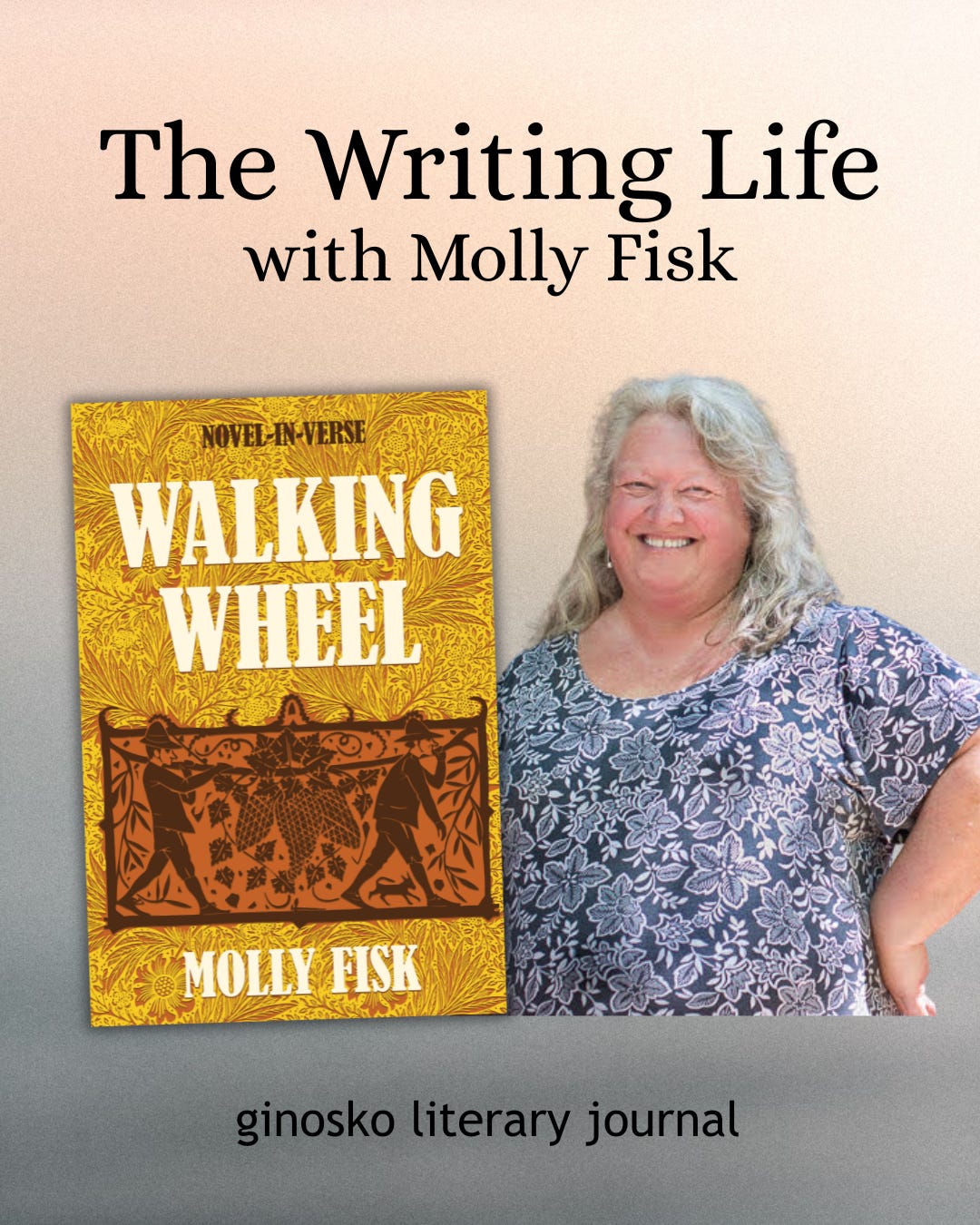
Poet Molly Fisk sits down with Ben C. Davies at Ginosko Literary Journal to discuss her writing life, influences, and creative practice, as well as her new novel-in-verse Walking Wheel (Red Hen Press), which reflects on love, labor, and everyday life in the American West.
About You as a Writer
What first drew you to writing, and what keeps you returning to it now?
I wasn’t a creative writer until I got into my mid-thirties and began to have traumatic amnesia recovery about childhood abuse. I’d written analyses of the Canadian Timber Industry when I was a banker and lots of personal letters. It never occurred to me to write a poem.
I’d been given Mary Oliver’s American Primitive for Christmas, and reading it was both comforting and inspirational. Idiotically inspirational, in that it was so conversational and open-hearted I thought I could do it myself. So I tried, and puttered around blindly, but after a while began to feel as though I’d discovered a way to work with issues and feelings that were very hard to make sense of in other ways. There was a therapeutic angle to it that was sanity-saving. And it was also fun, like a puzzle can be fun, but more inventive: figuring out patterns and connections.
I wrote by myself for six months, then took a week-long class with Anne Lamott , and through her found Dorianne Laux, who really taught me how to write poems. I studied with her for about four years, in Tuesday night workshops in her living room.
Now, 35 years later, writing is what brings me home to my truest self. I don’t write creatively every day, but usually 4 or 5 times a week, between poems and my radio commentary. If anything’s off kilter in my life, what solves it best or at least settles me down is to write something. It feels like opening a door to let the breeze in.
Which writers or poets have most influenced you?
Have those influences shifted over time?
The only poet I’d really read before this was Robert Frost, because my mother liked him so much and we spent time at her parents’ old farmhouse in Vermont, so I knew the landscape well. I love a lot of his work, the short pithy poems and his long story-telling ones with dialogue in them like “The Death of the Hired Man.”
Mary Oliver was the first contemporary poet I read, and her work can still catapult me out of any slump I get into. There’s a generosity and inclusivity in how she uses the general “you” that always opens me up. I found her in 1990, right before she began to get famous and seven or eight of her poems become banners for women in every kind of recovery. This overexposure can make her seem clichéd to some people, but the simplicity she wields cancels that out for me. And the fact that she wrote (very circuitously) about abuse was valuable.
After Oliver, through Dorianne, I was exposed to a wide array. I was much more influenced by women: Dorianne herself, Sharon Olds, Carolyn Forché, Lucille Clifton, Linda McCarriston, to some extent Jane Hirshfield, Kim Addonizio, Naomi Shihab Nye. They were the foundation on which I built my own work: women writing about things people didn’t talk about much then: child abuse, political assassination, families and addictions, love and sex from a female point of view. Intimate, real things that were unexpected if not outright taboo. There was so much inclusion of aspects of the body. That is abidingly important to me. Humans are sensate animals, that’s where the action is.
The men are great: Bob Hass, Tony Hoagland, Campbell McGrath, B.H. Fairchild, Phil Levine, so many. But they were at a slight remove from the subjects I was first exploring, so I don’t feel as tightly connected to them.
I don’t know that I feel influenced much any more, per se. I come upon writers whose work is new to me and fall in love. I discover poems I wish I’d written and lines I love and want my brain to learn how to write. There’s a swoon factor. But I don’t go home and try to write sonnets like Diane Seuss, or leaping, chatty, ricocheting lines like Bob Hicok and David Kirby. I probably should! I hope my synapses are absorbing what they do in a more unconscious way. Mostly I wish I could inhabit other people’s minds for a while.
Outside literature, what nourishes your creative imagination?
Oh, gosh, just about everything. The out of doors and its inhabitants, art of all kinds, dance, science, the weather... I write most about place, about what’s in front of me: my own landscape now in the Sierra foothills and the stresses it’s under, like wildfire, and the pleasures it affords, like swimming in “my” lake, Scotts Flat Lake, and watching ospreys dive right next to my head. Also my native landscape, my childhood landscape of Mount Tamalpais in Marin, and the places — Massachusetts, Vermont — I’ve spent long periods of time in New England.
I learned to paint with oils about ten years ago, and love doing that, interacting with color and shape instead of language. It’s very restful, but it’s also exactly as frustrating as writing poems when I can’t quite make something look the way I’m thinking of it. I’m not an accomplished painter, I’m having fun being a long-time beginner, but it’s a great antidote when my life gets too full of words.
What does your writing practice look like these days?
Do you have rituals, constraints, or habits that help you begin?
Who is that line from, about if you can’t be a shining example, you can go ahead and be a terrible warning? I’m in the terrible warning category, I’m afraid. My writing practice is not in the least bit organized, except by some undefinable internal system.
Early on I was lucky to find the Community of Writers, a conference up near Lake Tahoe, CA, whose week-long course for poets involved writing a poem every day and workshopping it the next morning. The staff did this as well as participants, so it gave me an egalitarian view of writing — renown and experience didn’t spare you from the work — and also a no-nonsense angle: “ideal” wasn’t really available with a deadline like that in an unfamiliar setting, so I learned to sit down and get cracking no matter where I was, something I value enormously and for which I’ll always be grateful. It also gave me a real poetry community of peers, mentors, buddies, the works, and I think one of the conditions for my writing is knowing I’m not alone.
People always ask, but no, I don’t write every day, at a designated hour, or in a special place. Lately I’ve found it incredibly productive to meet with a prose-writer friend and a timer. 25 minutes of silent writing, then a 5 minute break for more coffee, gossip, bathroom, etc. We usually do three of these in succession and we meet randomly: sometimes every day for a week, sometimes just once or twice a month.
Other than that, I either can feel a poem moving around somewhere in my head: a phrase or line, some rhythm, and I grab my notebook and sit down wherever I am. That’s the fun place to be. Or I feel faint stirrings of being antsy and irritable, so I pull the car over or park myself on a bench or a beach or under a beauty salon hair dryer and start writing. That’s to quell anxiety or crankiness, and it’s a little less fun, but the poems that arise from each kind of writing don’t reveal their roots.
What advice would you offer emerging writers and poets?
There’s so much advice out there, I hesitate to add any more! The one thing I don’t hear much about is memorizing, suggesting new writers learn poems and paragraphs they particularly love by heart. I’ve gotten a great education about how writing works from letting someone else’s language come out of my mouth. You find so many connections: internal rhymes, long strings of one letter or sound that lead you through a piece, the rhythm another writer is using that you couldn’t recognize on the page. Especially with poetry, which is historically sound-based as well as written to be read. The musicality of language is a big part of why we love it and this teaches you a little about how it works.
Be careful not to memorize something you don’t love, though, because those words will be running through your blood veins for the rest of your life!
Maybe this was more important to me as a poet without any formal training. I wasn’t taught to analyze poetry in that way, so when I did discover some clues to how poems were made, I was particularly thrilled. But try it. Try all kinds of things, that’s my real advice, and see if you like them or they help you make sense of what you’re doing or want to be doing in your work.
About Walking Wheel
For readers encountering Walking Wheel for the first time, how would you introduce the book?
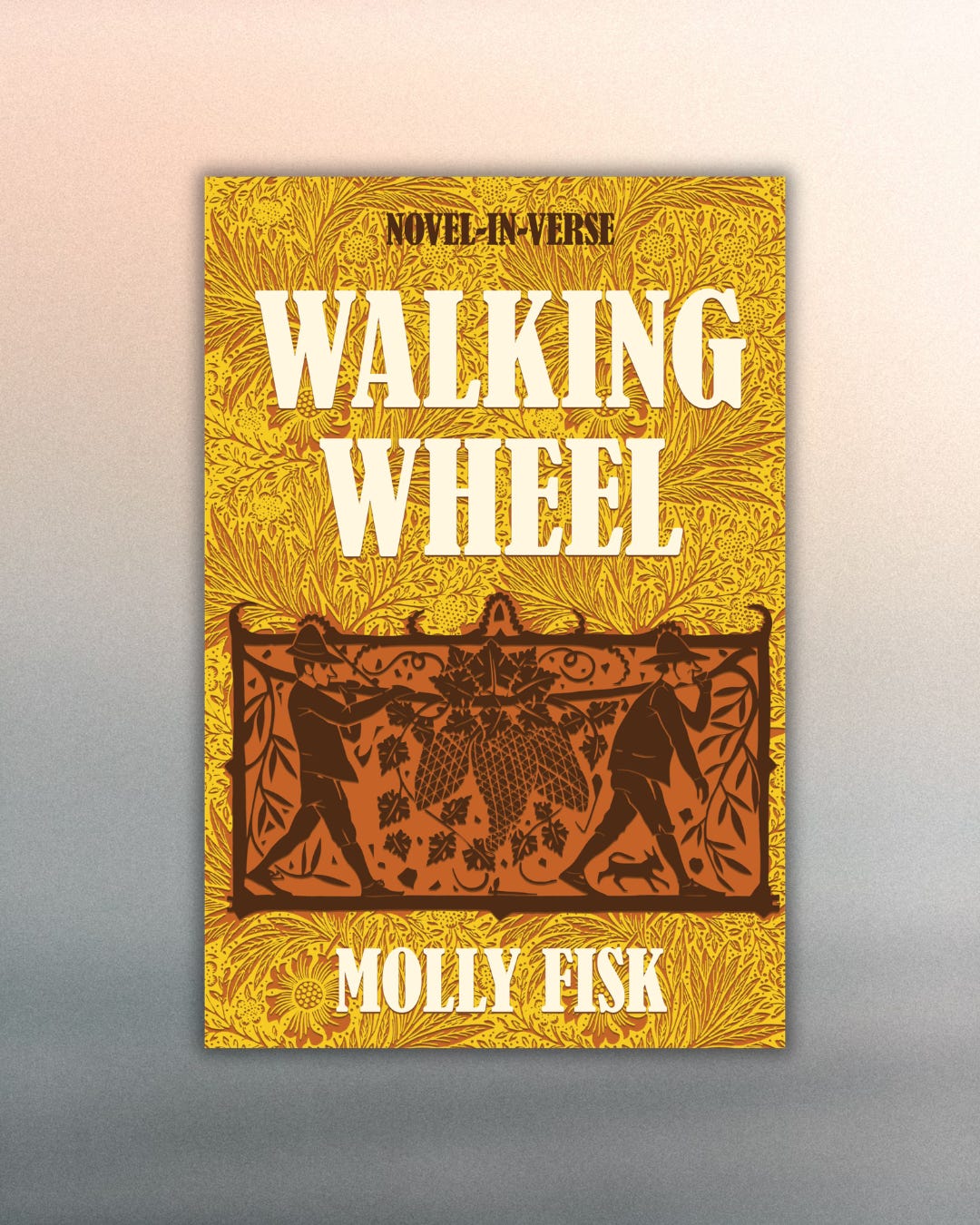
I’ve been saying it’s a love story set in the American West a generation after the Gold Rush, full of the ordinary hard physical work of that era. The first year of marriage for a couple in a new place, building a life away from their families. It’s intimate, both emotionally and because it’s focused so tightly on the two main characters.
What was the earliest spark or impulse behind this collection?
Did it emerge from a particular period, experience, or question?
My interest in “the west” as a fictional place has been pretty steady since I was a little girl, but a couple of pieces caught my eye in adulthood, and I’ll bet they were part of the spark. One is Molly Gloss’s The Jump-Off Creek, about a single woman homesteader in Oregon, which I loved and sold many copies of when I worked in a bookstore in the 1990s. The other horrified me: Annie Proulx’s short story “Them Old Cowboy Songs” (from her book Fine Just the Way It Is), about a young couple who have a baby and every possible disaster occurs, leaving both of them dead at the end. Right from the get-go, I wanted to describe all the work it took to stay alive in this kind of rural terrain, and also have nothing bad happen to my characters.
Walking Wheel is described as exploring ‘the ordinary tasks of love and work in 1875, a century we’ve almost forgotten.’ Why did you want to explore this century and these lives? Were there ideas or tensions you consciously wanted the book to explore?
I’m afraid I never consciously think about where a book is going or what it’s exploring. I’m not analytical about the process, or trying to steer. I let things unfold and see what happens.
I was noticing some of the skills my friends and I have and regularly use, we who are now in our 60s through 80s, that younger people, and especially city-dwellers, don’t seem to have. Making fires in a woodstove, cooking things from scratch, putting up jam, sewing and knitting, repairing. One of my grandmothers taught me a lot, when I’d stay with her in the summer, so I was also thinking of the circumstances under which we learn skills and pass them on.
Nevada City, CA, where I’ve lived for 30 years, is a Gold Rush town, so I’m surrounded by buildings and a landscape that refers to the past, not just for tourists but for those of us who’ve been here a while and watched it change. Many of us know the trees that were imported by early settlers, grown from seeds someone brought west, like Little-Leaf Lindens, and Mirabelle plums. There’s an abiding sense of history running beneath everyday life that I think affected me. Not everyone feels this, but a poet’s job is to slow down and notice things, and I think I wanted to experience the pace of life in an unelectrified, uncomputerized world. The pace and also the effort required.
Were there particular challenges in writing or shaping this book?
Did any poems resist you or take unexpected turns?
No individual poems were problematic, the big adventure with Walking Wheel was writing poems sporadically over twenty years without realizing I was writing a book. This is so different from my other poems and essays in subject and tone, I didn’t take it seriously for a long time. By the time I figured out it was trying to be a whole book, I had a huge continuity problem.
I’d just sort of written each poem by itself, in my mind, without reference. So I had to go back and try to sort them out, not just for meaning in relation to the one before and the one after, but also to not have summer last for two years, and Phoebe’s pregnancy stall out so she was in her third month for several months in a row. My early readers helped a lot with this. Weather, crops, and gestation, those were the problem! It took me about a year of working this out, some charts on the wall, pages of the book hung up in my kitchen on garden twine as if they were laundry... Luckily, my best friend from childhood was a midwife, so she looked at the book once I got it into a basic order. Instead of correcting things, she gave me a timeline of average pregnancies, so I had to do it myself, which was I’m sure the right thing to do but Lord it was hard. I had the baby doing somersaults in utero long before that would be possible.
I also blithely mentioned an herb for tea to be drunk during pregnancy because I liked the sound of its name—at this moment I can’t recall which one—and another friend who’s a nurse told me this herb can cause miscarriages, and I needed something else.
If readers carry one feeling or insight with them after finishing Walking Wheel, what would you hope it is?
I’d like them to feel that love is alive, and work is doable, and sometimes nothing goes wrong. That all is not lost.
As I was finishing the book and the world was starting to feel more uncertain and dangerous, I thought “well, maybe this story and the slower pace can help people escape, be a distraction.” But it’s turned into more than that, as I listen to reader reactions. It’s comforting, but it also provides a kind of relief, a reminder about the benefits of work and love. It’s a vote for humanity in a time when inhumanity is so prevalent.
Looking Ahead
What’s next for you?
Are you working on new writing, projects, or explorations in other forms?
I’m always writing my weekly three-minute radio commentaries for KVMR, our local station. That’s a steady beat in my writing life and the regularity of it keeps me on my toes. I might produce another book of those essays to accompany the first five volumes, but I’m not sure yet.
I have a new book of poems making the rounds of contests and publishing houses, called That Meadowlark, That Traveler. It’s a return to my normal style of writing present-day poems about climate crisis, the natural world, love and sex and heartbreak, lake swimming, small town life, birds. Whatever’s right in front of me.
I also have a small idea brewing about the place I swim, which is a reservoir that flooded a very small collection of houses, not even a town, in 1938. Something about what’s underneath us when we’re swimming — by us, I mean all swimmers everywhere.
I think about those many towns and farms and animal habitats that are gone. Plus things like the boats sunk in the English Channel that people are swimming over. I don’t know what to say about them yet.
More than that will have to be revealed in its own sweet time, I think.
Where can readers follow your work online?
(Website, newsletter, social media, or other platforms.)
I am easy to find on Facebook and Instagram, sometimes Bluesky.
To keep up with my current work and support me, there are free and paid options on Patreon. Website is: http://www.mollyfisk.com where you can buy books, find out about reading and teaching dates, and sign up for a very randomly-timed e-mail update or blog post.
If you like radio, my commentary streams on Fridays at 8:06 a.m. Pacific on: www.kvmr.org and is archived under Podcasts. The station also puts them up on Spotify.
Molly Fisk is a San Francisco–born writer whose new book Walking Wheel is now out with Red Hen Press .
Her books include the poetry collections The More Difficult Beauty (2010), Listening to Winter (2000), and Terrain (1998), as well as the radio essays Blow-Drying a Chicken (2013). She has also released radio commentary recordings, including Using Your Turn Signal Promotes World Peace (2005).
Fisk has received fellowships from the NEA, the Marin Arts Council, and the California Arts Council, among other honors, and served as Nevada County Poet Laureate from 2017–2019. She teaches writing and life coaching in Nevada City, California.
http://www.kvmr.org should work, I just checked it. In the text above there's a space missing between the website and "and" which might be the problem. People all over the world call in to say they've been listening. I'm so glad this was a little respite from world affairs for you and thank you for reading it.
The radio link says website can’t be reached.
I wonder if it works from anywhere in the world.
I’m in Paris right now, and am
Curious to know what the talk of the town is that part of the world.
When I was a boy, I used to listen to the VOA, Voice of America, in Jounieh, a coastal town in Lebanon, before the war, late at night on the short wave of my father’s Panasonic portable radio, to blues and country songs. I think I must have heard of Big Bill Broonzy, Johnny Cash and the Carter Family back then, because when I grew up, all those names sounded familiar to me.
It seems I’m still a curious person.
I’ve read your interview and it just pulled me back from the slump of the current world affairs.
Thank you.